
Anthony Shaffer’s Main Event

April 2, 2026
Anthony Shaffer’s Main Event
By Carla Steen
Resident Dramaturg
Sleuth is Anthony Shaffer’s first, most successful and best-known play. He wrote it in 1969, having left behind a career in advertising in hopes of becoming a playwright. His first draft was a conventional marital drama, which was, in his words, “the most threadbare, hackneyed, overused format known to the West End” (London’s Broadway). Only in removing the wife and mistress from the cast did he reveal its possibilities and create his ingenious game of a play. (It’s rumored that Andrew Wyke is based in part on composer Stephen Sondheim, famously an aficionado of games and puzzles.)
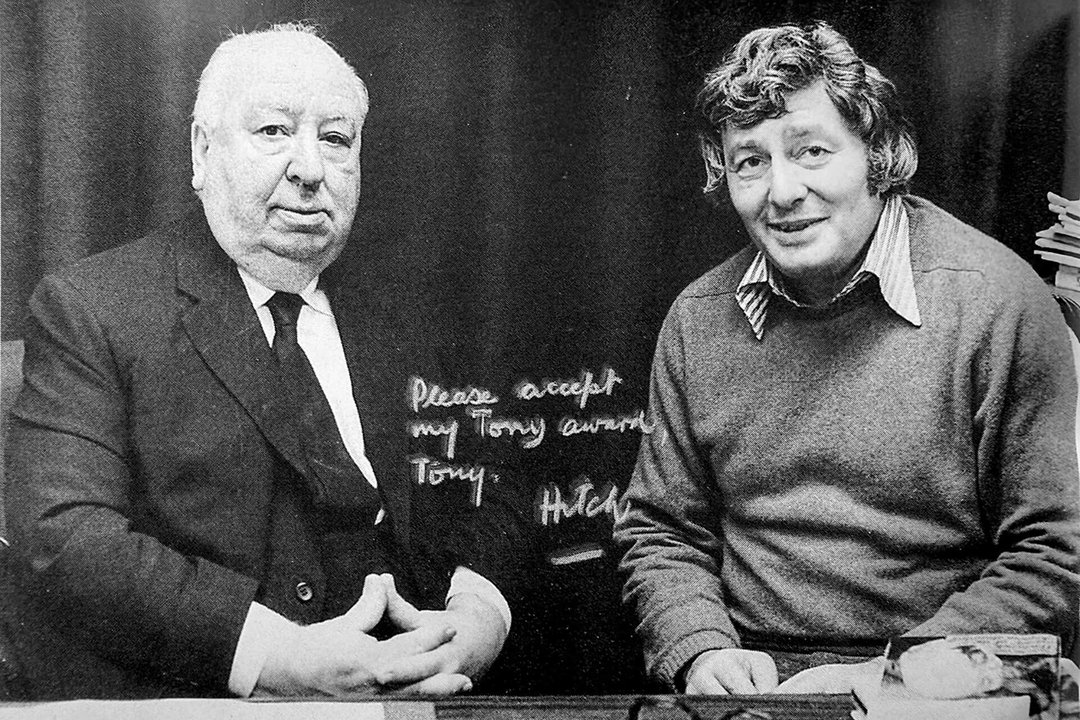
The drama opened in the West End in February 1970 and ran for five years. Its original cast moved to New York in November that year for the Broadway production, which ran for almost three years and received the 1971 Tony Award for Best Play. He also wrote the screenplay for the 1972 film version, headlined by Sir Laurence Olivier and Michael Caine, and directed by Joseph Mankiewicz.
If Shaffer’s name sounds familiar, it may be because he has a playwriting twin brother Peter, who wrote Amadeus, Equus and Lettice and Lovage, among others. The brothers were born on May 15, 1926, in Liverpool, England, where they lived until age 9 with their younger brother Brian and parents Reka and Jack, an estate agent. In 1935, the family moved to London, and the Shaffer boys attended the prestigious St. Paul’s School. World War II was ongoing when Anthony and Peter graduated secondary school, and military service loomed. After a rather disastrous interview to be part of the intelligence service, Anthony was conscripted (as was Peter) to work in the coal mines in Kent.
Ill health led Peter to leave mining after two years for Cambridge University, but Anthony had to wait until February 1948 to be discharged. He entered Cambridge that fall and, partly to appease his mother, studied law. He also edited the college magazine, Granta. After graduation, Anthony practiced divorce law for some years before making a career shift to advertising. In addition to working for several advertising companies and winning numerous awards, he established Hardy, Shaffer & Associates, a television production company, with Robin Hardy.
Eventually finding advertising to be unfulfilling, Anthony followed Peter’s advice to leave it all behind and finally embrace that he was a writer at heart. Shortly after leaving Cambridge, the brothers had used a pen name to collaborate on two books featuring the detective Mr. Verity. Peter had almost immediately established his career as a writer, including multiple successful productions. Now, with a family of his own to support, Anthony was nervous to jump into writing with no safety net, but his first effort out of the gate proved so successful he didn’t look back.
The success of Sleuth provided exciting opportunities, including writing the screenplay for Frenzy for director Alfred Hitchcock in 1972; the next year, he wrote the screenplay for the cult film The Wicker Man, which was directed by his former business partner Robin Hardy. Perhaps fittingly, as Sleuth both sends up and pays homage to the work of Agatha Christie, Shaffer was involved in four films based on her novels during the 1970s and 1980s: He offered uncredited assistance to director Sidney Lumet on Murder on the Orient Express, which led to writing Death on the Nile and Evil Under the Sun and co-writing Appointment With Death.
Shaffer followed a similar mystery-thriller vein in his work for the stage, including Murderer, in which he explored the idea that it’s the victim who searches for his murderer rather than vice versa, and Whodunnit, a complicated puzzle comedy of manners.
Despite a varied and successful career, nothing ever quite matched the success of Sleuth, the play for which Shaffer is best remembered — a prominence which he acknowledged by referring to it as “The Main Event.” Shaffer died in 2001 at age 75. His memoir, So What Did You Expect?, was published posthumously later that year.